Wednesday, May 27, 2009

Last Extra Credit of the Year, SEE BONUS AT THE BOTTOM


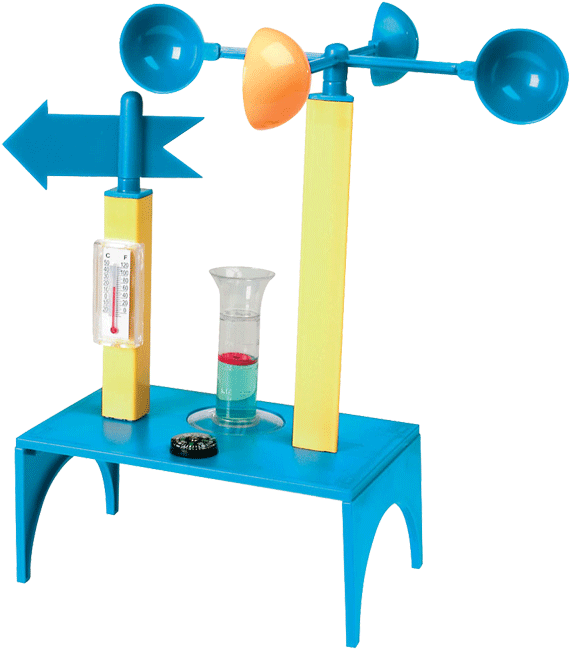
You can find your own directions to make any of the following weather instruments.
At the end of this message you will find more links to some places that I found with good directions. The ones found here are not your only sources.

Barometer (15 points)
Thermometer (10 points)
Anemometer (10 points)
Anemometer with wind vane (12 points)
Rain gauge (2 points)
Hygrometer or Psychrometer (8 points) + 2 more points for calculating the dew point and cloud base elevation.

After you finish building the weather instrument, you must validate it.
To do this, calibrate the instrument so that you know how to use it to obtain real data.
Then, take three separate readings at three different times (preferably on different days).
Compare the data you got with the actual weather conditions located here and here (check both!) Calculate your percent error for each of the three trials. This percentage is a measure of the accuracy of your instrument. You must turn this information in with the instrument you built by Friday, June 5.

More sources:
Very good directions for all the devices
PBS's instructions
Scholastic's instructions ... simple
YOU can find your own directions using a myriad of other sites as well.


-------BONUS-----------LEARN ABOUT THUNDERSTORMS---------------------
Earn 7 bonus points for going here, following the links at the bottom on each page,
and printing out the quiz results certificate at the end!

Friday, May 22, 2009

Friday, May 15, 2009

River homework


Click the link below. Turn in your printed certificate(s) on Monday.

http://www.sciencecourseware.org/VirtualRiver/

Monday, May 11, 2009

Homework - aquifers


Click the picture to start.
Due Wednesday in science notebooks.

Monday, May 04, 2009

Extra Credit #2

Here you go... extra credit DUE THIS FRIDAY...
Print out and turn in the certificate that you earn
when you finish this exercise.

Thursday, April 23, 2009

Virtual Earthquake E.C.


Click on the button. You must bring me the printed-out certificate by Monday, April 27th.

Thursday, March 26, 2009

Biogeochemical Cycles!


Here is the Word document so you can just click on the links...


And here is a powerpoint that summarizes everything in case you are having trouble
finding what you are looking for...courtesy of Mr. Hentz.

Wednesday, March 11, 2009

Balancing Equations Practice - extra credit


You can earn extra credit by downloading this Excel file
To practice, follow the directions on each page of the file (use the tabs at the bottom to move between pages). The first page is the easiest one... it gives you a little chart to keep track of the
numbers of each element.
FOR EXTRA CREDIT -
When ready, do the "Balance Equations Quiz" page and press to grade it.
Print out the resulting page which shows your score. If you screw it all up and want to start over, press to reset the page.
Put your name on the sheet and turn it in to me by next Wednesday.

Wednesday, March 04, 2009

Tuesday, February 17, 2009

Electrons and the Periodic Table


Download my pre-typed table of Ionization Energies!


Here is the electron configuration gizmo that you can do for extra-credit.
(Do the 5 assessment questions at the end of the gizmo. PRINT OUT and TURN IN the
results).

Tuesday, February 10, 2009

Extra Credit assignment


10 points.

How does a refrigerator (or air conditioner) work?

-Write a well-developed paragraph that clearly explains how the following key concepts from chapter 5 play a role in refrigeration. This marvelous technological advance of the early 1900's has improved people's quality of living all over the world.

KEY CONCEPTS:
  • latent heat (including heat of vaporization)
  • phase changes
  • Charles Law
  • heat flow
All of these come together in what is called the "refrigeration cycle" in your refrigerator. Questions to consider: If cold air exists inside the fridge and cold is the absence of heat, where does the heat go? Where does the heat from the food end up?
If you were to leave the refrigerator door open for a few hours on a hot summer day, could you cool your kitchen?
Would it be correct to say, in thermodynamic terms, that a refrigerator or air conditioner "moves heat"?

Including a diagram (your OWN diagram, not from the internet) will fetch you an additional 5 points if it explains the refrigeration cycle correctly.

DUE ON OR BEFORE FEBRUARY 20.

Friday, February 06, 2009


Here is the chapter 5 slide show!

Thursday, February 05, 2009

Problem Set 2 - selected answers

In random order, some even with units!

270

57.7

.082 g

300 K

2.5 kg

6000 cal

5000 cal

2

28.8

Friday, January 30, 2009

Specific Heat worksheet answers


1. Gold
2. Pure water
3. Silver because it has a lower specific heat, so better conductor
4. Aluminum
5. 20,920 J
6. At the same temperature, the larger mass of water contains more thermal energy
7. concrete has a lower specific heat so it heats up faster given the same energy input
8. Do this one after the calorimetry lab and it will be easy.
9. Figure this one out on your own. :)

back side
1. 323 J
2. 588 J
3. 2243 J
4. The gold would cool down fastest. It has to release only 323 J of energy to return to its original temp.
5. 711,280 J
6. 440,000 J
7. 5.6 degrees
8. 4,393,200 J
9. we will do this one next week.


Thursday, January 15, 2009

Final Exam Review Guide Answers

Final Exam Study Guide Answers.
*not all answers are on here, some excluded*
DON'T FORGET TO STUDY YOUR ASTRONOMY AS WELL!
ESPECIALLY STARS/THE SUN.

Page 1

1) a) 3
b) 5
c) 2
d) 3
e) 2

2) a) 270.00
b) 143
c) 87.2
d) 1.3 x 10^14
e) 2.0 z 10^14
f) 7 x 10^6

3) d) 7.56 x 10^-4
e) 0.0044
f) 13,000


Page 2

6) a) 10
b) 3
7) 7s
8) 7.6 m/s down
9) 1000 N
10) 1000 N
11) 25 N
12) 530 N
13) 1 x 10^-7
15) 1700 m
16) 0.9 m/s
17) 2.5 m/s


Page 3

18) force acts on it
19) momentum transferred


Page 4

2) 20 A will allow less current through
3) Same (full voltage) because it is a parallel circuit. Each device gets the full voltage of the battery.
4) 24 x 2.2= 52.6 volts
5) 4.0W/12V= o.3 amps
6) 45/0.38= 118.4 volts; V=IR so R=V/I so 118.4V/0.38= 312 ohms
7) So others remain on if one fails


Page 5

1) continous/visible spectrum
2) gamma
3)photon
4) violet
5) refraction
6) potential; kinetic
7) work; force
8) watt; joule
9) renewable
10) 4x

1) See bottom of pg. 96 in book
2) Equal
3) perpendicular for transverse; parallel for longitudinal
4) light behaves like particles
5) energy of atom executes electron and moves up level(s) as electron drops and emits photon
6) radiant- from sun
electromagnetic- em waves electric, magnetic fields
thermal- heat
nuclear- nucleus energy, sometimes particles
7)a) sound waves are longitudinal, slower, and compress matter. Light waves are electromagnetic, faster, and photons.
b)renewable- can be regrown; nonrenewable- replenishing takes 1,000,000+ years
c) work is FxD; power is W/T


Page 6

1) 67 degrees
2) 22.0 kilograms
3) 4.4 x 10^-18 joules
4) 19.3 hertz
5) 0.2 m
6) 4.75 m
7) 4.2 x 10^17 hertz
8) 1.44 x 10^18 joules
9) 15 m/s
10) 0 joules
11) 100 joules